 Prime Years Health

Key takeaways
- Morning breathing after 50 feels heavier when small things stack up: normal lung aging, dry bedroom air, mouth breathing and less daily activity.
- Start with pursed-lip breathing: in through the nose for two counts, out through pursed lips for four.
- See a doctor for shortness of breath, chest pain, wheezing or a cough lasting more than three weeks.
- On supplements: talk to your doctor first, choose a form your body can absorb, and think in months, not days.
In this article
- Why do mornings feel heavier after 50?
- Is dry air really that big a deal?
- What breathing exercise do you teach first?
- When should someone stop reading articles and see a doctor?
- Patients ask me about turmeric supplements. What do you tell them?
- How long before people notice a difference from new habits?
- If you could give one piece of advice?
- Readers asked: is there a supplement that fits these criteria?
- Frequently asked questions

Every week our inbox fills with versions of the same question: "Why do I wake up feeling like I can't get a good breath going?" We collected the seven questions you ask most and put them to someone who spends her days teaching people to breathe better. We asked her to be blunt, including about supplements.
Why do mornings feel heavier after 50?
"It's usually several small things stacking up. Lung function declines gradually after about age 35; that's normal aging, not a disease.1 On top of that, the bedroom air is often too dry when the heat runs all night, a lot of people breathe through their mouth while sleeping, and many of us move less than we used to. Each one is small. Together, you feel it in the first hour of the day."
Is dry air really that big a deal?
"It's the first thing I ask about. The EPA recommends indoor humidity between 30% and 50%.4 In winter I hear about bedrooms at 20%. Then people wonder why their throat feels like sandpaper at 6 a.m."
"My advice is boring but it works: buy a cheap hygrometer and measure. Don't guess. Owning a humidifier isn't the same as having the right humidity."
What breathing exercise do you teach first?
"Pursed-lip breathing, every time. It's the one the American Lung Association recommends, and anyone can do it.2 Breathe in through your nose for about two counts. Then purse your lips like you're blowing out a candle and breathe out slowly for about four counts. The longer exhale is the point."
"Then belly breathing: one hand on your chest, one on your belly, and let the belly do the moving. Five minutes in the morning, by a window if you can. People feel silly for about three days. Then it becomes the best five minutes of their morning."
When should someone stop reading articles and see a doctor?
"I'm glad you asked this one. Habits are for everyday comfort. They are not for symptoms that need a diagnosis."
Patients ask me about turmeric supplements. What do you tell them?
"I get this question constantly. Here's what I say. First: a supplement is not a treatment, and it is never a replacement for your medication or the habits we just talked about. Second: talk to your doctor first if you take blood thinners or diabetes medication, are pregnant, or have gallbladder issues. That one's important."
"Third: if you're going to take one, take one that's actually absorbed. Turmeric has a lot of research behind it, mostly on its antioxidant properties,8 but the NIH is clear that the research in people is still developing.6 And plain curcumin is poorly absorbed. The studies on black pepper extract (piperine) are the reason I tell people to look for it on the label.7"
"And last: give it time. People take something for ten days, feel nothing, and throw it in a drawer. That's not a fair test of anything you take daily. Think in months, not days."
How long before people notice a difference from new habits?
"Fixing the air and drinking water first thing, some people notice within days. Breathing exercises and walking take a few weeks to feel natural; the CDC recommends working up to 150 minutes of moderate activity a week.5 And anything you take daily, you judge over two to three months. The people who do best are the ones who expect a slow climb and don't quit on the first bad morning."
If you could give one piece of advice?
"Same routine, every morning, in the same order. Consistency beats intensity. Nobody's lungs were ever helped by a perfect week followed by a month of nothing."
Angela's 10-minute morning routine
- Check the hygrometer: aim for 30%–50% in the bedroom.
- A full glass of water before coffee.
- 5 minutes: pursed-lip breathing, then belly breathing, by a window.
- Light stretching: arms overhead, open the chest.
- A walk, even 10 minutes, building toward 150 minutes a week.
Readers asked: is there a supplement that fits these criteria?
This section was written by our editors, not by Ms. Ruiz, who does not endorse specific products.
After this interview ran in our newsletter, many readers asked which supplement matches what Ms. Ruiz described: a turmeric extract that's standardized, includes black pepper extract for absorption, makes no cure claims, and can be taken with meals as part of a routine. One option that checks those boxes is LungVicks.
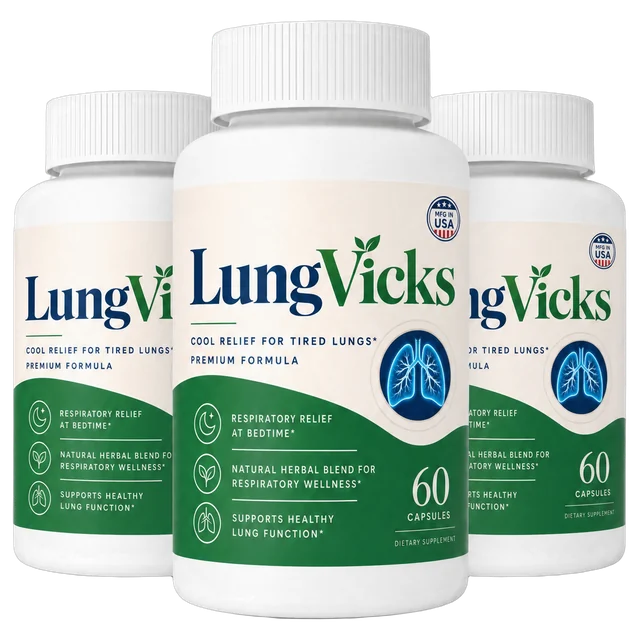
LungVicks: what's in the bottle*
- Turmeric extract standardized to 95% curcuminoids
- BioPerine® black pepper extract for absorption
- 60 capsules per bottle: one with breakfast, one with dinner (a 30-day supply)
- Made in the USA · sold only on the official site
Before you add any supplement
- Talk to your doctor first if you take blood thinners or diabetes medication, are pregnant or nursing, or have gallbladder or liver problems.
- Keep doing the routine above. A supplement adds to habits; it doesn't replace them.
- Give it 8 to 12 weeks before you judge it.
Frequently asked questions
Why do mornings feel heavier after 50?
Several things add up: lung function declines gradually after about age 35, bedroom air is often too dry when heating runs all night, many people breathe through the mouth while sleeping, and less daily activity means less breathing reserve. Most of these can be improved with simple habits.
What breathing exercise should I start with?
Pursed-lip breathing: breathe in through your nose for about two counts, then breathe out slowly through pursed lips for about four counts. The American Lung Association recommends it to help you breathe more efficiently.
When should I see a doctor instead of trying new habits?
See a doctor for shortness of breath at rest or with light activity, chest pain, wheezing, coughing up blood, or a cough lasting more than three weeks. These are not symptoms to manage with habits or supplements.
Can I take LungVicks if I take medication?
Ask your doctor or pharmacist first and bring the label. Turmeric can interact with some medications, especially blood thinners and diabetes drugs. Never stop or change a prescribed medication on your own.
- American Lung Association. Lung Capacity and Aging.
- American Lung Association. Breathing Exercises.
- American Lung Association. Warning Signs of Lung Disease.
- U.S. Environmental Protection Agency. A Brief Guide to Mold, Moisture and Your Home.
- Centers for Disease Control and Prevention. Adult Activity: An Overview.
- National Center for Complementary and Integrative Health (NIH). Turmeric.
- Shoba G, et al. Influence of piperine on the pharmacokinetics of curcumin in animals and human volunteers. Planta Medica. 1998;64(4):353–356.
- Hewlings SJ, Kalman DS. Curcumin: A Review of Its Effects on Human Health. Foods. 2017;6(10):92.